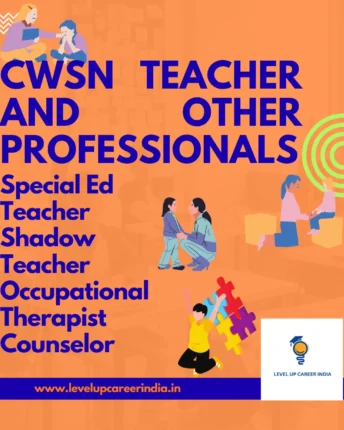
In this post you will get to know about the shortage of CwSN teachers and other professionals and is a complete guide on How to Teach, Identify, Train, and Build a Career in Special Education in India.
Shortage of CwSN Teachers and Professionals
More than 2.1 million Children with Special Needs (CwSN) are enrolled in Indian schools, according to the UDISE 2023–24 report, underscoring the rising need for specialized educational support. However, by 2022, only roughly 100,000 people were registered with the Rehabilitation Council of India (RCI), even though the 2011 Census estimated that 1.5 million certified special educators were needed.
To guarantee that every kid receives the assistance they are entitled to, there is an urgent need for qualified experts as well as increased societal and governmental focus on inclusive education, which is highlighted by this huge disparity between supply and demand.
Working with children with special needs (CwSN) is not just a career it’s a calling. Whether you’re a teacher, counselor, therapist, a parent or if you had been a CwSN yourself, your role can change how a child sees school, and more importantly, how they see themselves. This post will walk you through how to identify and teach CwSN students, what training and qualifications you’ll need, what kind of professionals work in this field, and what kind of salary and career growth you can expect.
What Professionals Work with CwSN
Working with CwSN is a team effort. In a typical inclusive setup, these professionals collaborate:
- Special Educator / Resource Teacher – Designs Individualised Education Plans (IEPs).
- Occupational Therapist – Improves fine/gross motor skills, daily living activities.
- Speech Therapist – Works on speech, vocabulary, articulation, fluency, communication for daily living and gradually updating as per the need of the child.
- Behavioural Therapist – Addresses behavioural or emotional regulation issues, gives helpful tips to handle such children.
- Counselor / Psychologist – Supports mental health, coping skills, and motivation.
- Shadow Teacher – Offers 1:1 classroom support for inclusion.
- Parents – The most consistent teachers a child has.
Also read: Introduction about CwSN
How to Become a CwSN Teacher or Special Educator
If you feel drawn toward helping children with diverse needs, here are the courses and qualifications to build your career:
| Role | Recommended Courses | Duration | Approx. Fees (₹) | Where to Study |
| Special Educator / CwSN Teacher | Diploma in Special Education (D.Ed-SE), B.Ed/M.Ed./PG Diploma/ MA/D.Ed. in Special Education (recognized by RCI) | 2 years | 40k–1.5L | IGNOU, NIEPID, Rehabilitation Council of India approved institutes,Pvt and Govt Universities |
| Occupational Therapist (OT) | Bachelor of Occupational Therapy (BOT) | 4.5 years | 2–5L | AIIPMR, SRM, Manipal |
| Behavioural Therapist / ABA Therapist | Certificate in Applied Behaviour Analysis (ABA), PG Diploma in Behavioural Therapy | 6 months–1 year | 30k–1L | National Institute for Empowerment of Persons with Disabilities, private training centres |
| Shadow Teacher | Certificate in Inclusive Education / Early Intervention / Autism Support | 3–6 months | 15k–60k | Online courses (NCERT-Swayam, Coursera, Alison) and NGOs |
| School Counselor / Child Psychologist | M.A. in Psychology / Post Graduate Diploma in Guidance and Counselling | 1–2 years | 50k–2L | IGNOU, Jamia Millia Islamia, NCERT |
| Speech and Language Therapist | BASLP (Bachelor of Audiology and Speech-Language Pathology) | 4 years | 2–5L | AIISH Mysuru, Manipal, Amity |
| Special Needs Assistant / Resource Teacher | Certificate in Inclusive Education or D.Ed Special Education (Cross Disability) | 1–2 years | 30k–80k | RCI-approved institutes, Open Universities |
Note: RCI (Rehabilitation Council of India) approval is a must for most special education courses. Always check their official list of recognized institutes.
CwSN Training for Teachers
Where to Learn
- Government Programs: Samagra Shiksha and NCERT regularly conduct training for inclusive education.
- DSWSC – The (RCI) Rehabilitation Council of India has recognized the DSWSC to run courses for intellectual disabilities. Every year, the Institute brings out successful Special Educators who are placed in reputed schools in Delhi and other parts of the country. (https://www.dswspecialchildren.in/teacher-training-institute)
- Online Learning:
- DIKSHA Portal offers free modules on inclusive classrooms.
- IGNOU Certificate Courses in special education.
- RCI Short-Term Programs.
- SCERT and Samagra Portals
Training Certificates
After completing online/offline modules, teachers can download training certificates from DIKSHA or respective department portals — these often count for professional development credits.Training certificates for teachers can be downloaded after course completion from DIKSHA, SCERT, or Samagra portals.
Salary and Career Growth
Salaries vary widely depending on the role, experience, and organization type:
| Role | Salary Range (Monthly) | Sector |
| Special Educator / CwSN Teacher | ₹20,000 – ₹45,000 | Schools / NGOs / Govt Schemes |
| Occupational Therapist | ₹25,000 – ₹60,000 | Hospitals / Therapy Centres |
| Behavioural Therapist | ₹20,000 – ₹50,000 | Private Clinics / Inclusive Schools |
| Counselor | ₹25,000 – ₹55,000 | Schools / NGOs |
| Shadow Teacher | ₹15,000 – ₹30,000 | Schools / Home-based Support |
| Speech Therapist | ₹30,000 – ₹60,000 | Hospitals / Therapy Centres |
With higher qualifications and experience, many professionals also move into consulting, training, or school leadership roles.
Alongwith their salary as per their job as highlighted here via Glassdoor, they can also take up extra classes for additional special students and get additional pay,and as the demand is growing many people prefer to get special educators at home.
How to Identify CwSN Students
It is usually the teachers who notice first and report to the parents if they fid some kind of delay or some issue where the child needs help as they’re the ones who are seeing a batch of same age kids in the class, so it is very important that the teachers are well versed and guide the parents at the right time to the right place.
- Early signs: Struggling to read, write, or focus; difficulty in speech or social interaction; delayed motor milestones; or frequent withdrawal in class.
- Talk to parents: Teachers often notice issues first so gentle conversations with parents can help connect dots.
- Seek expert opinion: For official identification, children are assessed by specialists and issued a Disability Certificate by competent medical authorities.
- Documentation: Schools fill out CwSN forms (available under state education or CBSE guidelines) to register such students for accommodations and support.
Tip: Trust your instincts as a teacher. If something feels “off,” don’t ignore it,early intervention makes a lifetime of difference. Also read: Introduction about CwSN
How to Help CwSN Students Thrive
- See them as children first, labels later.
- Make small, consistent adaptations in lessons.
- Build a support circle around them comprising of parents, peers, professionals.
- Celebrate progress, not perfection.
Inclusion isn’t about lowering the bar , it’s about building a wider bridge.
How to Handle CwSN Students
- Stay calm and compassionate. Their frustration often comes from feeling misunderstood.
- Build routines predictable structure helps children with ADHD, ASD, and anxiety.
- Praise small wins. Confidence is half the battle.
- Work closely with parents and specialists.
- Keep a progress record both for academic and behavioural growth.
How to Teach CwSN Students
Teaching CwSN students requires more creativity than curriculum. Here’s what really works in classrooms:
1. Adapt, don’t simplify
Break concepts into smaller steps, use visual or tactile materials, and allow students to learn at their pace.
2. Multisensory teaching
Combine sound, visuals, touch, and movement. For example, use sand tracing for writing practice or counting beads for math, fidget toys, movement breaks, physical tasks like carrying notebooks for the class, which can make them feel responsible and also meet their proprioceptive need.
3. Peer learning
Encourage group work where peers help and learn empathy. Inclusion should be real, not just on paper.
4. Use TLM (Teaching Learning Materials)
For CwSN, TLM can include tactile flashcards, braille charts, visual cues, or even digital apps with interactive exercises.(TLM also available on Diksha)
5. Teach in Hindi or local language
Use simple, familiar Hindi phrases. Reinforce instructions visually and orally. Children grasp better when you speak their comfort language.
Conclusion
If you’ve ever felt that teaching should mean something, this is the field for you. Working with CwSN teaches patience, empathy, and perspective in ways no textbook ever could. The journey may be demanding, but the rewards; a smile, a first word, a breakthrough are life-changing.
The progress is slow but the joy is remarkable when your student is becoming better. And a person who has been a CwSN will have an unmatched empathy for another CwSN and will be the most relatable and their connection would also be a beautiful one, so if you’ve have it in you, then do help people in need, as the need is ever rising.
Also read: Inclusive Education-case study