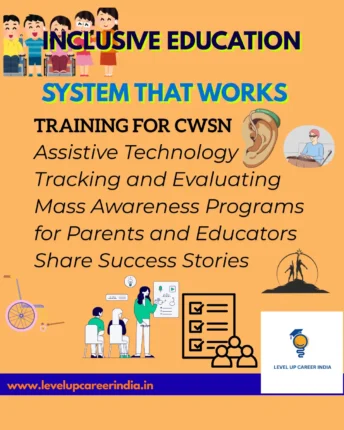
Imagine a classroom where every child raises their hand because they are all given the opportunity to shine, regardless of how they study, move, or communicate. Inclusive Education for CwSN looks like this, where we get to see the real talent, abilities which are hiding behind the disabilities (as often pronounced, pun intended).
Children with special needs (CwSN) are still much too frequently ignored in India, but things are starting to change. From private schools in Bengaluru to slums in Mumbai, inclusive classrooms are changing lives by providing optimism, self-assurance, and tangible outcomes. This article examines the implementation and effects of inclusive education, including how it functions, where it is successful, and what still needs to be changed.
Also read: Introduction about CwSN
Real-Life Success Stories That Inspire
- a) From Mumbai’s slums to school cheers
Get ready to meet the real hero not covered by the mainstream media Mr Bhadane, a special educator who found through the Sarva Shiksha Abhiyan program, 14-year-old Javed Shaikh, who has cerebral palsy and hearing loss, attended a mainstream school in Mumbai’s Sewri slum. His experience demonstrates how inclusive behaviors can lead to opportunities. Read the story here - b) Rural Rajasthan’s shift to inclusive learning
Differentiated instruction and inexpensive assistive technology increased the engagement and regular attendance of children with learning difficulties in a rural government school funded by the Unessa Foundation.
These illustrations show that inclusive education is feasible in a variety of contexts, not just urban elite schools. Success stories of Inclusive Classroom
What’s Working: Key Elements of Impactful Inclusion
It is important that the above success stories can only be achieved if the resources are utilised optimally, and the people involved should be trained, informed, and sensitised, as when they don’t know what they are dealing with, they can’t have the requisite empathy and the methodology to show results with them.
- Teacher Training & Sensitisation: Teachers with inclusive pedagogy training have a significant impact. According to a Himachal survey, many teachers were unaware of inclusive education. IER Journal
- Assistive Technology and Learning Tools: Assistive Technology and Learning Tools: Children with sensory, physical, or cognitive impairments can access curriculum through the use of audio books, Braille devices, and graphical worksheets. Consider the implementation of Braille devices in Prayagraj schools. The Times of India
- Individualised Support & Resource Rooms: Having resource centers, therapists, or special educators makes it easier for kids to receive the individualized care they need.
- Peer Support & Collaborative Learning: The classroom culture changes toward empathy and group development when peers without disabilities take part in inclusive activities.
As a society also it is very important to have empathy, as this cut-throat competition has snatched empathy from young minds and have become self centered, at the cost of others, business mindset also teaches the similar mindset, so to inculcate the feeling and empathy towards others, feeling of gratefulness, this kind of culture, where they feel empowered by helping others in need, is cultivated from a young age and thus we have people who have similar thought process in the society.
- Accessible Infrastructure: Smaller class sizes, restrooms, ramps, and assistive technology all help to achieve true inclusion.
Also read: Professionals for CwSN
Limitations in Applying Inclusive Education
A typical classroom plus a student with special needs is not an inclusive classroom. In order for all children, including those who are classed as CwSN, to learn together, the environment, pedagogy, tools, and culture must be modified. It includes teacher preparation, peer assistance, assistive technology, tailored instruction, and accessible infrastructure.(A study)
Inadequate infrastructure, big class sizes, and a lack of teacher preparation are the main obstacles to inclusion, according to research conducted in India. A case study conducted in South Delhi revealed that there are still substantial pedagogical and resource disparities in inclusive education.
Where the Gaps Are & How to Close Them
Even with advancements, many schools continue to face difficulties. The challenges faced by them are as follows:
- One teacher is attempting to assist numerous students with a variety of needs in large class sizes.Science Publishing Group
- Teachers are not receiving ongoing professional development in inclusive practices.
- Social attitudes and stigma: inclusion is still seen as charitable rather than a right.
- Unequal distribution of resources and infrastructure (private against public, urban versus rural). What can be done? A gap which needs to be addressed.
- According to the Rights of Persons with Disabilities Act of 2016, for instance, policy execution must align with intent.
- Allocate funds for support services, assistive technology, and training.
- Parent and community involvement to strengthen inclusion in the home and in society.
- Tracking and evaluating the results of inclusion (performance, retention, attendance).
- Schools and legislators may transform policy into altered real lives by emphasizing impact rather than merely inclusion in principle.
CwSN- An Undiscovered Field of Work
- If you’re training for CwSN certification: choose modules that cover assistive tech, differentiated instruction and inclusive classroom practices.
- If you’re a teacher or school admin: examine your class set-up. Are children with disabilities truly included? Do you have access to resources? Are teachers trained?
- If you are a parent: demand inclusive practices. Ask schools about their special educators, resource rooms, peer programmes and accessibility.
- If you are a content creator on education: share real stories, highlight gap-areas, and push for better visibility of inclusive education, spread awareness as many people aren’t aware of this.
Next Step: Building the Future
India’s educational system is undergoing a sea change. The National Education Policy (NEP) 2020 places a strong emphasis on inclusive education for all, therefore scaling best practices, minimizing regional inequities, and ensuring that every classroom is truly inclusive are the next steps. As a member of this ecosystem whether you’re a teacher, parent, student, or mentor, you have the power to change things by encouraging, supporting, and standing out for inclusive education.
Our educational system as a whole advances when not a single child with special needs is left behind. And this begins with getting the certification done. Read: How to get CwSN certificate
Conclusion
In India today, inclusive schools are impacting lives and are not just a fantasy. From Javed in Mumbai to the pupils in rural Rajasthan, it is evident that children with special needs flourish when schools adapt, teachers learn, and resources are available. But the true test is how many of these classes there are, how many kids are being included in a meaningful way, and how we fill up the gaps.
Use this information as a starting point to understand inclusive education and take action, and spread awareness to take the necessary steps as Mr. Bhadana took the step to get that child out of his house and give him his right to education which is also mandated by law under Right To Education Act,(RTE Act, 2009).